
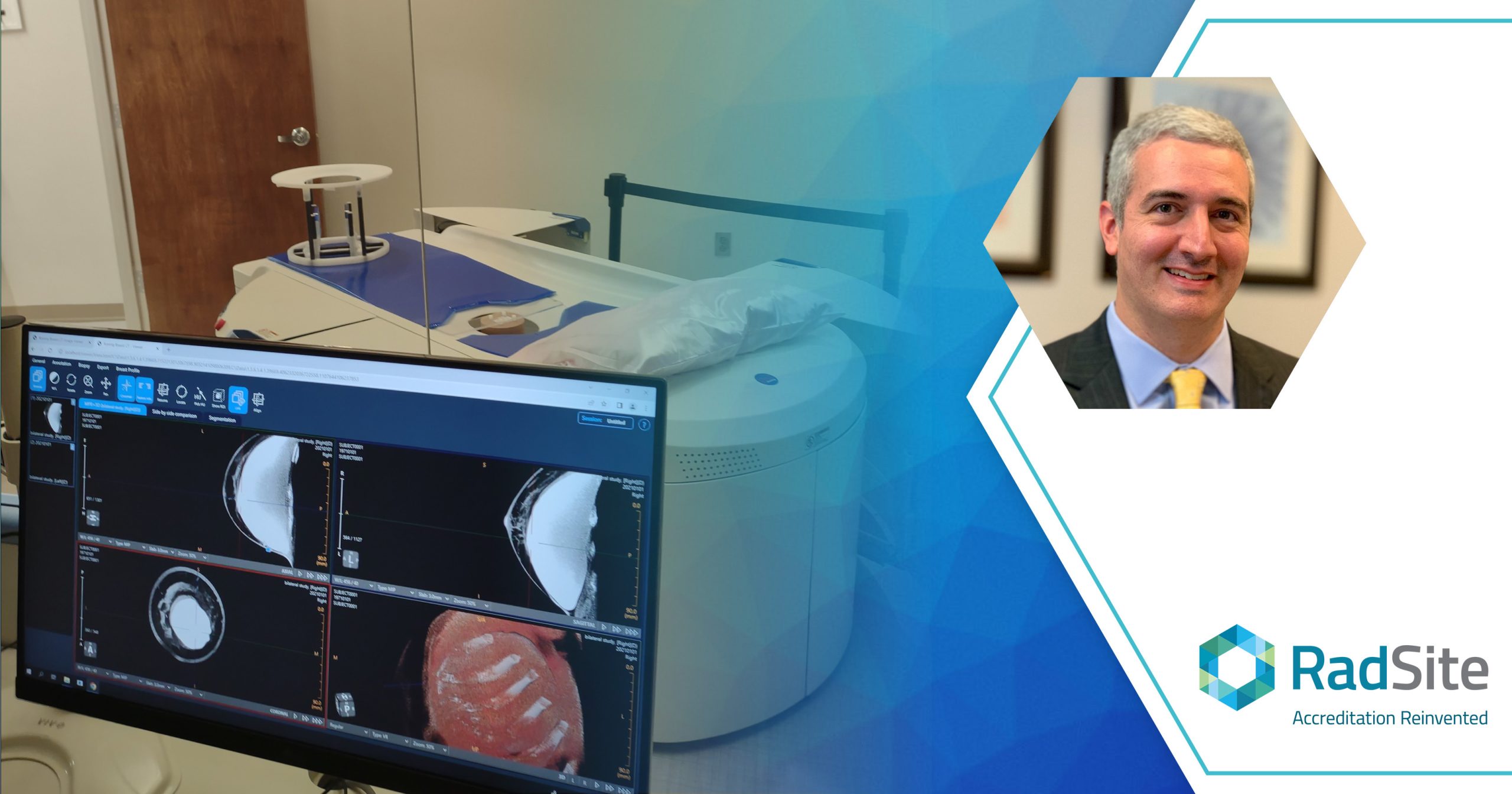
Richard Reaven, MD, serves as Co-Chief Medical Officer at Koning and is a recognized expert in breast imaging. He earned his medical degree from Northwestern University Feinberg School of Medicine before completing an internship at Greater Baltimore Medical Center. Dr. Reaven then completed his residency in Diagnostic Radiology at the University of Maryland, where he served as Chief Resident, followed by fellowships in Breast Imaging and MRI. In addition to his role at Koning, he is a partner at Advanced Radiology in Maryland and was recently appointed Clinical Assistant Professor at the University of Maryland Medical Center.
Why is breast cone beam CT generating so much interest in breast imaging?
Dr. Reaven: Our job as breast imaging radiologists is to find and diagnose breast cancer at its earliest and most treatable stage. We have many tools in our toolbox, but each of them has limitations. Breast cancer is an extremely common disease; about 1 in 8 women will develop breast cancer in their lifetime. Technologies that may improve cancer detection while providing a better patient experience are generating significant interest.
How does breast cone beam CT improve visualization of breast anatomy and tissue detail?
Dr. Reaven: The breast is a three-dimensional organ, and just like any other part of the body, requires truly three-dimensional cross-sectional imaging to find small abnormalities. A conventional mammogram is a 2-dimensional imaging modality, similar to an x-ray. Even the newly touted 3D mammogram (aka “tomosynthesis”) is more similar to an x-ray than to a cross-sectional imaging modality such as CT. We use chest x-rays for many purposes in radiology, but if we are looking for small lung cancers, we would always use truly three-dimensional CT technology due to the superior spatial and contrast resolution.
Why does 3D imaging matter when looking for breast cancer?
Dr. Reaven: Breast cancers are dense. Almost half of women in this country have dense breast tissue. Trying to find a dense cancer in a dense breast is like trying to find a snowball in a snowstorm. Three-dimensional imaging allows radiologists to review tissue layer by layer, which can make subtle abnormalities easier to see. This may be particularly important in women with dense breast tissue, where mammography has known limitations.
How does breast cone beam CT improve patient comfort and overall imaging experience?
Dr. Reaven: Traditional mammograms require compression to spread out the overlapping architectural structure of the breast with the goal of finding anatomic abnormalities. The issue is that the amount of force required to separate these tissues can be quite high, causing significant discomfort for the patient. Breast cone beam CT is performed without the same level of compression, which may improve comfort during the examination. For women with breast implants, it also avoids the high levels of compression that can raise concerns about implant-related complications. For women with breast implants, there is the added concern of the compression causing rupture of the implant or of the capsule that forms around the implant. This can lead to more discomfort and disfigurement.
What workflow efficiencies or operational benefits have you observed with breast cone beam CT?
Dr. Reaven: In the current standard mammographic workflow, a woman will come in for a screening mammogram on day 1. If a potential abnormality is detected, she will typically get a letter in the mail any time from 10-20 days later. She then has to schedule a diagnostic mammogram, which can take up a few weeks. The entire reason diagnostic mammograms exist is because the screening mammogram is not good enough to answer all of the questions. With CBCT, we are able to answer virtually all of the clinical questions in one fell swoop of 7 seconds of imaging per breast.
What benefits does breast cone beam CT offer for imaging patients with dense breast tissue?
Dr. Reaven: Traditional mammography may miss up to 30% of cancers in women with dense breasts. CBCT, on the other hand, has been shown in some studies to find more abnormalities than traditional mammography. The sensitivity (detection rate for abnormalities in women with breast cancer) has been shown in comparative studies to be significantly higher for CBCT compared to traditional mammography.
What are the biggest operational challenges when integrating CBCT into an existing breast imaging practice?
Dr. Reaven: For those that are choosing to integrate CBCT into an existing breast imaging practice, I would say that the biggest challenge is deciding which patients will be imaged using the different modalities. I would expect most women given the chance to choose between traditional compression mammography and compression-free CBCT would choose the more comfortable and compassionate breast cone beam CT option.
What barriers currently exist to wider adoption of breast cone beam CT in breast imaging centers?
Dr. Reaven: Awareness is by far the biggest obstacle to wide-spread clinical adoption in my opinion. Patient awareness, primary care doctor awareness, and even radiologist awareness should all be addressed if we are going to see more widespread clinical adoption.
What does the current clinical evidence say about CBCT’s role in breast cancer screening and diagnosis?
Dr. Reaven: There was a meta-analysis performed last year which included almost 850 patients across multiple studies, each comparing traditional mammography to CBCT. The meta-analysis showed that the sensitivity for CBCT was 92%, whereas the sensitivity for traditional mammography was 77%.
What has the FDA approved breast cone beam CT for today, and what might change in the future?
Currently the FDA Diagnostic indication for breast CBCT allows for the following indications: breast pain, palpable lump, follow-up from screening mammography, further evaluation of abnormal or incomplete imaging, planning for biopsy, breast implant evaluation, monitoring for chemotherapy, and for those women who cannot undergo traditional mammography. The FDA Screening indication is in the works and will hopefully be decided soon. If that comes to pass, all women above the age of 40 will be able to have access to this groundbreaking imaging technology.
What excites you most about the future of breast cone beam CT?
Dr. Reaven: We are still learning where breast cone beam CT can have the greatest impact. As more research is published and more centers gain experience with the technology, its role in breast imaging will become clearer. The early results are encouraging, and I believe CBCT has the potential to become an important addition to breast cancer diagnosis and patient care.