
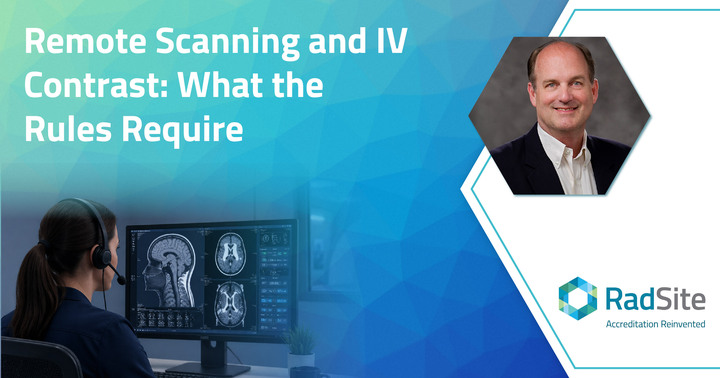
The rapid adoption of remote scanning technology is transforming the radiology landscape and helping address ongoing technologist shortages. However, when remote scanning technologists operate CT or MRI scanners, qualified staff must still be physically present in the scanning suite with the patient.
Remote scanning, virtual physician supervision, and contrast administration are distinct functions with different regulatory and clinical requirements. Because contrast administration may require an immediate response, trained staff must be present with the patient during contrast-enhanced CT and MRI exams.
Although imaging workflows are evolving, the underlying principles of patient safety remains a constant. To that end, RadSite’s CT and MRI Accreditation Standards require the physical presence of qualified and experienced staff for high-risk clinical tasks. These requirements are consistent with state regulations, which vary by jurisdiction but consistently require appropriately licensed personnel to perform contrast administration.
The individual who starts the IV and administers contrast—typically a registered nurse (RN), a radiologic technologist (RT), or a physician—must be present and licensed to perform that task. A remote technologist, regardless of proficiency, cannot satisfy the requirement for on-site contrast administration from a distant console.
Some imaging facilities have misread the “Direct Supervision” policy of the U.S. Centers for Medicare & Medicaid Services (CMS) as permitting remote contrast administration. CMS allows a supervising physician to be available in real time by audio and video for certain services under Medicare rules, but this applies only to supervision—not to IV placement or contrast injection.
Imaging facilities must maintain a well-defined emergency response plan, including staff training, contrast reaction management, and clear protocols for patient safety.
To learn more about this topic, listen to RadSite’s complimentary webinar, “Impact of Virtual Supervision & Remote Scanning on Administration of IV Contrast in CT and MRI Imaging,” via RadSite’s YouTube channel.
For imaging facilities, the takeaway is clear: Remote scanning is a tool for operational efficiency, but it does not replace on-site clinical accountability and expertise. To remain compliant with RadSite Standards and state regulations, imaging facilities must ensure that a qualified, licensed professional is present with the patient, ready to manage contrast administration and respond in real time to any potential adverse reactions.
To learn more about RadSite’s imaging accreditation programs, check out www.radsitequality.com.